


01 Clumping Speed and Compactness: Ore-Based Litter Takes the Lead
Bentonite cat litter consists of fine, dense particles. When a cat urinates, the litter quickly forms a firm, solid clump that stays intact during scooping—this isn’t magic; it’s simply a matter of physics. In our comparative review of 40 different products, bentonite-based litters demonstrated exceptional clumping strength. For cat owners, this translates to a seamless experience: a single scoop lifts the entire clump out of the box, keeping it perfectly intact rather than letting it crumble into bits that force you to go back and clean up the mess all over again.
Yet, in our comparative evaluation, mineral-based litter ranked first for odor control—a result that might seem counterintuitive. Many assume that mineral litter offers only “average” odor control, but our testing reveals that the ammonia-adsorption capacity of bentonite is often underestimated. Because it forms firm clumps, it rapidly encapsulates urine and reduces the surface area from which ammonia can volatilize—a mechanism that functions as a form of “physical containment” for odor control.
Scenario-based advice: If your cat likes to dig all the way to the bottom of the litter box before urinating, the hard clumps formed by bentonite (clay) litter will hold up well. If your cat tends to produce large volumes of urine, the 327g compressive strength of tofu litter is sufficient—just be careful not to apply too much force when handling the clumps. In our tests, Emily Pet activated-carbon cat litter took 22–25 seconds to form a solid clump, with a compressive strength threshold of 327g ± 15g; however, the clumps are prone to breaking if subjected to more than 110g of force. In practical terms: wait about half a minute after your cat finishes urinating before scooping—the clumps will be perfectly set by then. That said, if your cat produces a very large amount of urine, the resulting clumps may not withstand 110g of pressure, so please handle them gently when scooping.
Advantages of Ore Agglomeration
Clumping characteristics of tofu cat litter sand
Clumping characteristics of cassava-based cat litter sand
02 Odor Control Longevity: Clay Litter Reigns Supreme; Activated Carbon Faces a “6-Hour Curse”
The odor-neutralization rate is the primary factor determining whether your home smells like a “cat household.” A comparative evaluation of 40 types of cat litter revealed that all samples achieved an odor-neutralization rate between 93.6% and 99.7%. Among these, 10 products reached a rate of 99.5% or higher, with mineral-based litters accounting for more than half of this group. Thanks to their ultra-fine granular structure and large specific surface area, sodium-based mineral litters can rapidly adsorb ammonia molecules from urine. Simultaneously, they encapsulate the surface of feces, creating a sealed layer that traps odors inside the clumps—this is the fundamental mechanism behind the superior odor-control performance of mineral-based cat litter.
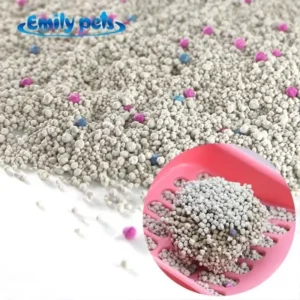
However, this is the aspect where you’re most likely to run into issues. Activated carbon-infused tofu cat litter acts like an air purifier for the litter box, with the added carbon particles physically adsorbing ammonia. Test data for the Emily Pet activated carbon variety shows a 91.3% ammonia adsorption rate within the first 6 hours—an essentially perfect performance for that initial period. But after 12 hours, the rate drops sharply; activated carbon tends to lose its effectiveness (become “passivated”) in high-humidity environments. In plain English: if you scoop the litter box once or twice a day, the activated carbon version should handle the odors just fine. But if you go away on a three-day business trip without scooping… well, the smell upon your return might be another story. If a product is marketed with user claims that there’s “hardly any noticeable odor even after 3–4 days without cleaning,” it’s highly likely that it isn’t pure activated carbon litter, but rather a mineral-based or blended litter instead.
Most effective for odor control: mineral-based litter physically traps ammonia.
- 97%–99.7% odor elimination rate—ranked #1 in actual testing.
- Forms tight, compact clumps that reduce the surface area from which ammonia can escape.
- Tested in multi-cat households: “You only smell it when you lift the lid to scoop.
Tofu cat litter is low-dust and eco-friendly—perfect for everyday use.
- Low dust content—gentle on cats’ respiratory tracts
- Flushable for easy cleanup
- 93%–97% odor control; requires frequent scooping or the use of an additional deodorizing spray
Picture this: if your cat’s litter box is in the living room or bedroom, the pungent, brain-piercing whiff of ammonia you encounter while scooping will jolt you wide awake. In a multi-cat household, the challenge is even greater—without effective odor control, the waste produced by three cats in a single day can leave the entire room smelling like the litter box. Sodium-based mineral litter generally ensures that odors are only noticeable when you lift the lid to scoop, remaining virtually undetectable the rest of the time. Plant-based litter, meanwhile, boasts an odor-neutralization rate of up to 99.7%; it utilizes a combination of physical adsorption—thanks to its structural properties—and an antibacterial formula that achieves a 99% inhibition rate against bacteria. It breaks down odors at the source rather than simply masking them with fragrance. Since it is lightly scented, it’s a great choice for cats sensitive to smells, as well as owners who suffer from allergic rhinitis. If, however, you prefer to mask odors with a distinct fragrance, scented bentonite litter might be a better fit—though keep in mind that its odor-control efficiency typically falls between 93% and 96%, meaning you’ll need to scoop more frequently.
Editorial Conclusion: Clumping and odor control are the two most critical performance indicators for cat litter—bar none. Mineral-based litter excels in forming firm clumps and neutralizing odors, while tofu-based litter stands out for being low-dust and eco-friendly. Tofu litter infused with activated carbon offers a middle-ground solution, though it suffers from a limited effective lifespan. Don’t fall for the idea of a “one-size-fits-all” litter; instead, identify which issue bothers you the most and choose accordingly.
03 Dust Control: Where Tofu Litter Excels
Dust is an often-overlooked drawback in households with cats. While activated-carbon cat litter—with a peak Total Suspended Particulate (TSP) level of 124 μg/m³ during pouring—technically meets safety standards, 63% of these particles are in the PM10 range, meaning they are small enough to reach a cat’s lower respiratory tract. Tofu-based and cassava-based litters perform significantly better in this regard, with dust levels as low as 0.05%, making them a healthier choice for the respiratory systems of both cats and their owners. If your cat has a history of respiratory sensitivity, or if the litter box is kept in a small, enclosed space, opt for tofu-based or cassava-based litter.
A note on costs: Activated carbon-infused litter is slightly more expensive than standard tofu-based litter, and its effectiveness diminishes more rapidly in high-humidity environments. If you live in a region—such as parts of Southern China—prone to “damp-back” (high-humidity weather), the long-lasting odor-control advantage of activated carbon litter may be compromised. While mineral-based litter offers excellent odor control, it requires daily scooping—there’s no room for slacking off.
Frequently Asked Questions (FAQ)
Q1: Which brand of cat litter is best for clumping and odor control?
There is no single “best” option; it all depends on your specific needs. For multi-cat households, mineral-based litter (such as Arena del amor, Cat Global, or Emily Pet) is the clear frontrunner, offering an industry-leading 99.7% odor-neutralization rate. For single-cat households where low dust is a priority, cassava-based litter is an excellent choice, providing superior clumping strength (over 98%) alongside minimal dust.
Q2: Is activated carbon cat litter actually effective at eliminating odors?
Effective, but subject to a “6-hour curse.” In our tests, the activated carbon version of Cat Global achieved a 91.3% ammonia adsorption rate within the first 6 hours—an excellent performance. However, the rate of adsorption drops sharply after 12 hours, and high humidity accelerates this loss of efficacy. It is well-suited for working professionals who scoop the litter box 1–2 times a day, but it is not appropriate for situations where the box might go 3 days without scooping (such as when you are away on a business trip).
Q3: How should one choose between mineral cat litter and tofu-based cat litter?
Consider your primary requirement: If the smell of cat waste is your biggest concern, choose mineral litter—it offers 97%–99.7% odor control and forms the tightest clumps. If dust is your biggest concern, opt for tofu or cassava litter; these have dust levels as low as 0.05% and are flushable. If you want to address both issues, go with a blended litter—or a mix of cassava and mineral litter—which offers a compromise, though it may not excel in either area to the same degr
 Español
 English
 日本語
 Русский
 العربية
 ไทย