
A hands-on soy-based litter evaluation from Heart-Fluttering Cat Cart — what actually matters when you source for cats, owners, and B2B buyers.
Over the years, the variety and number of cat litter brands have exploded, yet it remains incredibly difficult to find one that clumps well, doesn’t stick to the bottom of the box, offers superior odor control, appeals to my cat, and comes in convenient packaging.
For the happiness of cat owners and their feline friends, “Heart-Fluttering Cat Cart” brings you a tofu cat litter review — also a soy cat litter review, since tofu litter is soy-based!!!
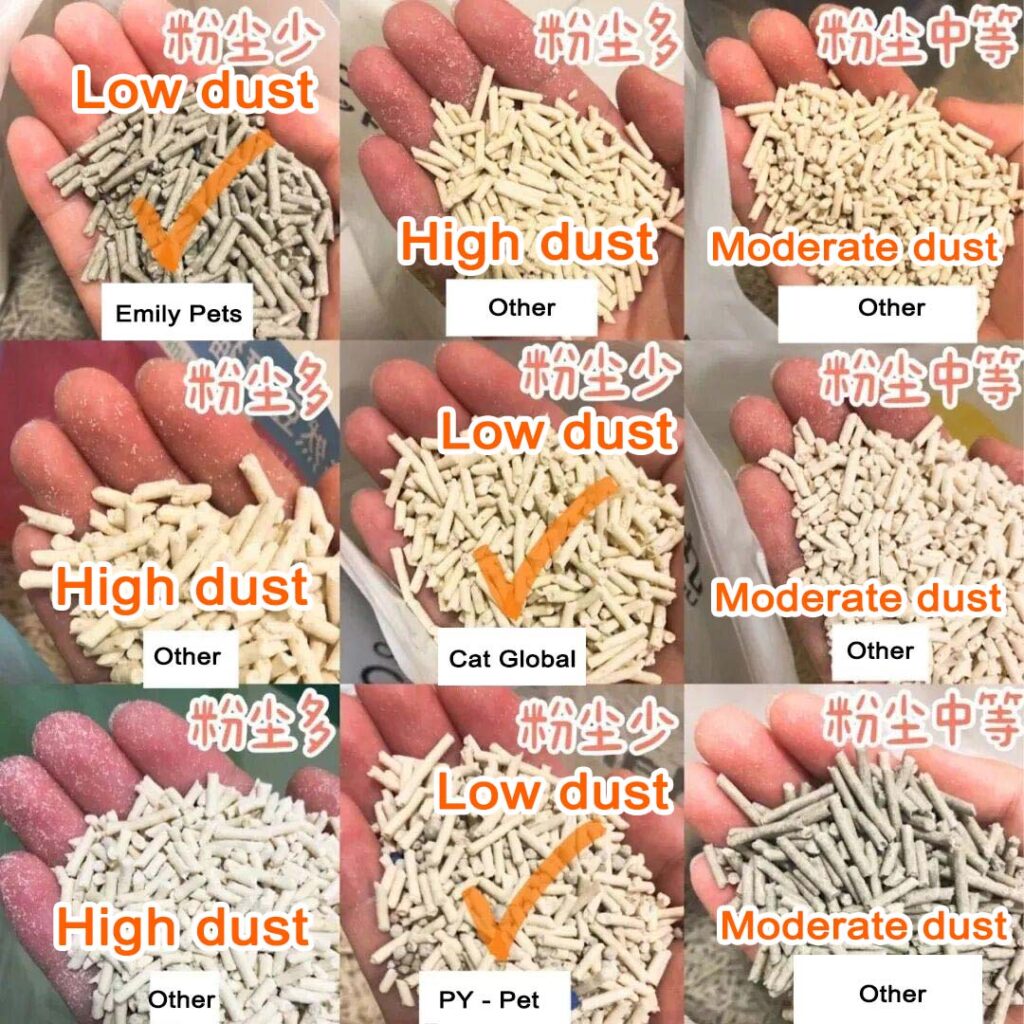
Dust particle size
In terms of dust levels, Emily Pets, Cat Global, and PY-PET produce relatively less dust, making them strong contenders for the best dust free cat litter.
Dust (particle) size is a key physical indicator determining the usability and safety of cat litter, influencing virtually every aspect of the user experience. The following breakdown examines this across four dimensions: impact on cats, impact on humans, product performance, and production.
I. Impact on the cat’s health (most critical)
- The smaller the particle, the greater the danger: fine dust particles smaller than 10 µm (in the PM10/PM2.5 range) are the ones that become airborne and get inhaled. Cats are obligate nasal breathers with long nasal passages that are sensitive to airborne particulates; long-term inhalation irritates the nasal mucosa and can trigger or exacerbate conditions such as feline asthma, bronchitis, and chronic coughing.
- Bigger is safer: granules larger than 1 mm generate virtually no dust, meaning there is almost no risk of inhaling it when the cat digs in or buries waste.
- Cats also ingest dust while grooming: fine particles are easily inhaled or enter the mouth and are subsequently swallowed during grooming. Ingesting large amounts of clumping bentonite litter poses a risk of intestinal obstruction (which is why plant-based or low-dust litters are recommended for kittens or cats recovering from surgery).
II. Impact on Human (Pet Owner) Health
- People can inhale the dust kicked up when pouring or scooping the litter. Low-dust litter is practically a must-have for households with asthma sufferers, people with allergies, pregnant women, or children — exactly what the best low dust cat litter delivers.
- This is also why “dust-free,” “99% dust-free,” and “low dust” have become key selling points in Western markets—reflecting the fact that the granules are large enough to prevent dust from rising.
III. Production / Quality Control
Dust particle size can be controlled through the manufacturing process; this is precisely the “consistency” that B2B buyers care about most:
- Dust particle size can be controlled through the manufacturing process; this is precisely the “consistency” that B2B buyers care about most:
- Multi-stage screening: Using screens of various mesh sizes to remove fine particles smaller than 0.3 mm or even 0.5 mm (corresponding to the “fine particle removal” step shown in the diagram).
- Washing / Air classification / Dust removal: Raw bentonite powder often contains fines; a combination of washing and gravity-based dust removal can significantly reduce the fine particle content.
- Moisture and binders: Controlling moisture levels and binding agents during the molding process of plant-based litter (such as tofu or cassava varieties) helps minimize breakage and the generation of dust.
- This is the core challenge for any cat litter low dust formulation: It is not enough to look only at the average size; the proportion of fine particles must also be considered—even with the same average particle size, a product with a higher content of fines will generate more airborne dust.
Clumping ability
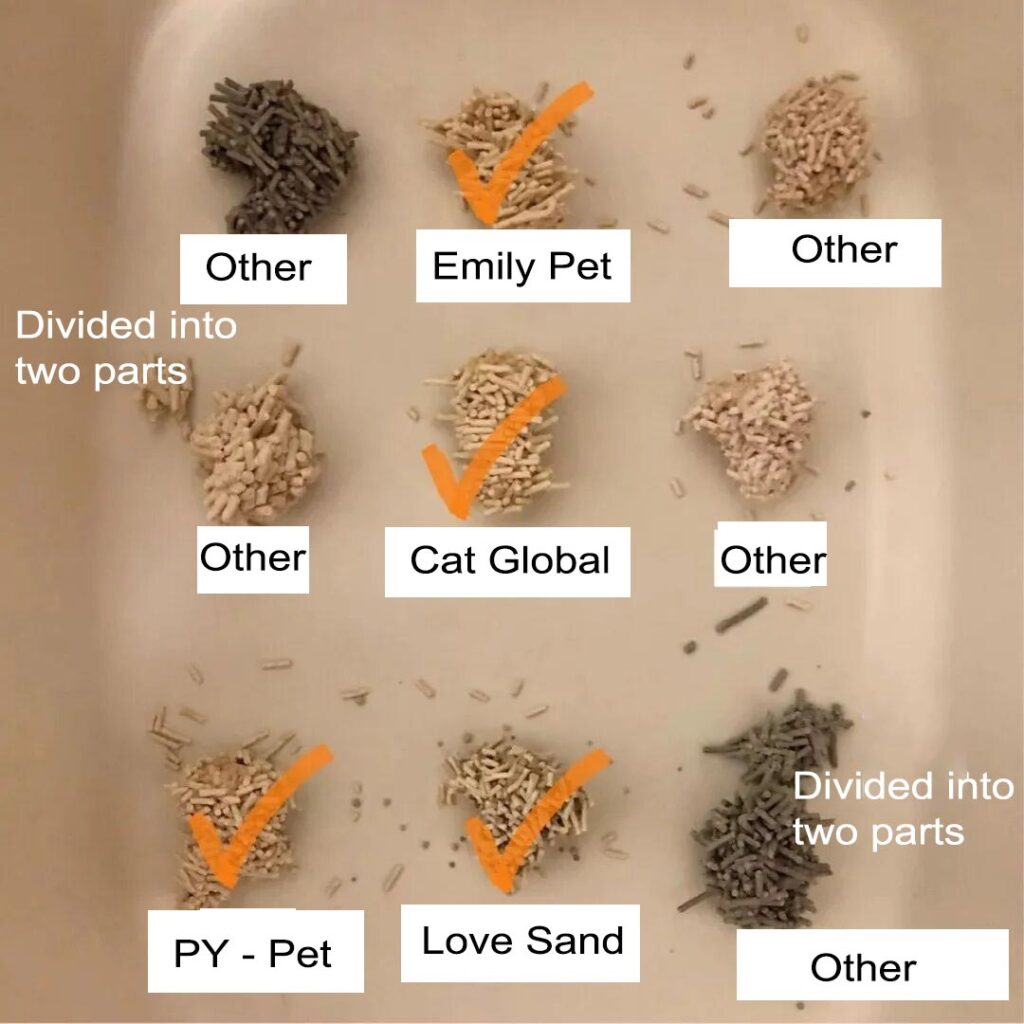
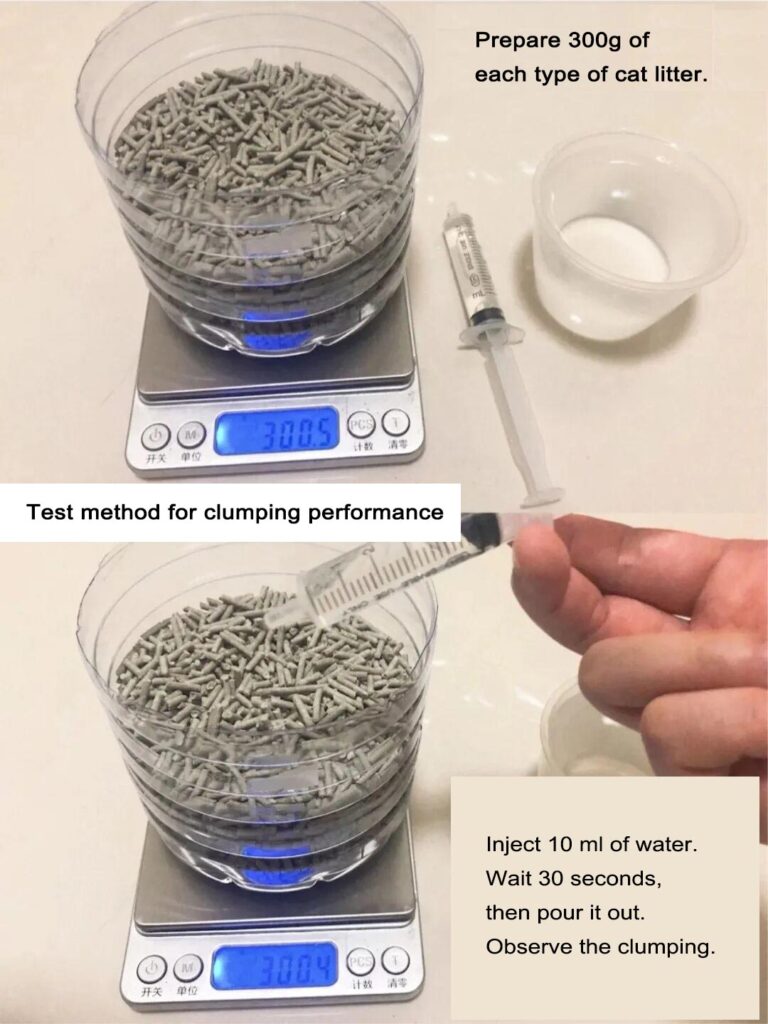
Test method: Prepare 300g of each type of cat litter and pour it into a cup. Pour 10 ml of water for 30 seconds and then pour it out to observe the clumping and sticking to the bottom.
Among them, Emily Pets and Cat Global form relatively firm clumps — a benchmark of low dust cat litter clumping.
“Clumping” refers to the ability of cat litter to rapidly form a solid, intact clump upon contact with urine. It is the most highly valued performance indicator for bentonite-based litters and is becoming increasingly important for plant-based litters (such as tofu or cassava). The impact of this property is explained below across four dimensions.
I. Impact on the cat’s health (most easily overlooked)
- Good clumping means “encapsulating” the urine: as soon as the cat urinates, the surface instantly forms a clump, preventing urine from seeping onto paw pads, fur, or the bottom of the box; it barely sticks to the cat when they move around or bury their waste.
- Poor clumping spells disaster: urine spreads across the bottom of the box, forming a wet, mushy layer. If the cat steps in it, the fur on their paws gets wet → the cat grows to dislike the litter box → this leads to inappropriate elimination or litter avoidance, with the cat potentially relieving themselves on the bed or sofa instead. This is often the hidden cause behind a cat “suddenly peeing outside the box”—it isn’t the cat’s fault; it’s the litter’s fault.For kittens, cats recovering from surgery, or those with sensitive urinary tracts, the damp environment caused by poor clumping can also easily trigger skin or urinary issues.
II. For Pet Owners (The Most Direct Experience)
- Good clumping: You simply scoop out a few “urine clumps” each day; the bottom of the litter box stays clean, and the entire batch of litter lasts for weeks.
- Poor clumping: Urine seeps to the bottom and forms a hard crust (often called “sticking to the bottom”), making it impossible to scoop or pry loose. Eventually, you have to dump out the entire box and refill it—wasting litter and money, plus creating an odor.That is why terms like “easy to scoop,” “scoopable,” and “non-stick” are key factors influencing purchasing decisions in Western markets, as they directly reflect the quality of the clumping.
Ⅲ、Regarding odor control (strongly correlated with clumping)
- The foul odor of cat urine stems from the volatilization of ammonia. Good clumping seals the urine inside the clump, effectively “locking in” the ammonia; this is precisely what the best cat litter for odor control and dust-free promises; poor clumping allows urine to pool at the bottom, continuously releasing odors and attracting small flying insects.
IV. Production / Quality Control
Agglomeration characteristics are process-controllable.
- Bentonite: The content of montmorillonite (especially the sodium-based type) determines clumping strength; calcium-based bentonite clumps much more weakly. Particle size distribution and moisture content also have a direct impact.
- Plant-based litter (tofu/cassava): Starch/plant fiber content, as well as the density and moisture level during molding, determine whether the litter clumps effectively upon contact with water without falling apart.
- Quantifiable metrics (most useful for specifications): Clumping time (seconds), compressive strength of the clump, resistance to disintegration after 24-hour immersion, and resistance to fragmentation.
- Common pitfalls: Adding too much binder to accelerate clumping leads to increased dust and a hard feel underfoot; making granules too fine to reduce dust results in brittle clumps. This represents a manufacturing trade-off between dust levels and clumping performance — the defining challenge of a low dust clumping cat litter.
Low Dust Tofu Cat Litter FAQ
Real-world performance, dust control, clumping and odor control for plant-based tofu cat litter.
How does tofu cat litter perform in a real-world review?
In our tofu cat litter review, the standout performers (Emily Pets, Cat Global, PY-PET) produced relatively less dust while still forming firm clumps. Tofu litter is soy-based, so it is also effectively a soy cat litter review — plant-based granules minimize breakage, reduce airborne fines, and clump on contact with urine.
What is the best dust free cat litter?
Brands such as Emily Pets, Cat Global, and PY-PET produce relatively less dust and are strong contenders for the best dust free cat litter. Dust control is achieved through multi-stage screening that removes particles smaller than 0.3–0.5 mm, plus washing and air classification.
Why is the best low dust cat litter important for households?
Low-dust litter is practically a must-have for households with asthma sufferers, allergy sufferers, pregnant women, or children, because pouring or scooping kicks up inhalable dust. This is exactly what the best low dust cat litter delivers — granules large enough to keep dust from rising.
What does cat litter low dust formulation require?
For cat litter low dust formulation, average particle size alone is not enough — the proportion of fine particles must also be minimized. Multi-stage screening, washing, and controlled moisture/binders during molding keep the fine-particle content low so less dust becomes airborne.
Does low dust cat litter clumping still hold up?
Yes. In testing, Emily Pets and Cat Global formed relatively firm clumps — a clear benchmark of low dust cat litter clumping. Good clumping seals urine inside the clump, preventing it from seeping to the bottom of the box.
What is the best cat litter for odor control and dust-free performance?
The best cat litter for odor control and dust-free performance seals urine inside a solid clump, effectively locking in ammonia before it volatilizes. Poor clumping lets urine pool at the bottom and continuously release odor, attracting insects.
What is the trade-off in a low dust clumping cat litter?
A low dust clumping cat litter faces a core manufacturing trade-off: too much binder accelerates clumping but raises dust and creates a hard feel underfoot, while granules made too fine to cut dust become brittle and break apart. Controlling both particle distribution and binder content is the defining challenge.
 English
  日本語
日本語  Русский
  العربية
  Español